On being somewhat stupid

Polaroid 600 SE, 75mm Mamiya lens, Fujifilm FP-3000B

So back when Polaroid called it quits, I bought a lot of film directly from them. I bought mostly the peel-apart pack film: 669, 664, and 690. Back then, in 2008, I shot some of the 690 film and was dismayed to find out it was actually grid film. I had intentionally bought expired grid film before (in drug stores and on eBay) for the novelty of it, but only in the Spectra format. Basically grid film overlays a grid over the image, with labeled axes, so you can “name” a particular point on the image. I guess it was used primarily for crime scene documentation, but I can see that it would be useful for a lot of stuff. In fact, the film package included a guide to what the distance between grid lines was based on your distance to the subject. But this 690 grid film didn’t have that. I was ticked off because I couldn’t really call Polaroid (now vanished) and exchange the film. I felt like the victim of a bait-and-switch.
Read more…

Arlo Day 9

Arlo, January 9, 2011. Polaroid Big Shot and type 669 film.

I’m seeing that I’m going to have to clean the spreaders on the Big Shot (the camera I’m using) after each pack. It likes to eat these film sandwiches. Luckily, I’ve made it most of the way through this pack so far (crossing fingers I make it through film 10). The key is to pull them perfectly straight–any slight angle brings the edges of the film paper against the sharper edges of the film spreaders.

Arlo Days 6-8

Arlo was still asleep when I had to leave for an overnight trip.

Arlo, January 6, 2011. Polaroid Big Shot and type 669 film.

And then I got stuck in a six-hour traffic jam on I-84 last night until the wee hours of this morning, so Kristen took this one on my behalf.

Arlo, January 7, 2011. Polaroid Big Shot and type 669 film.

This morning, things are back on track.

Arlo, January 8, 2011. Polaroid Big Shot and type 669 film.

Arlo Day 5

Day 5 of Arlo every day in Polaroid. Taken with a Polaroid Big Shot and Polaroid type 669 film.

Arlo, January 5, 2011. Polaroid Big Shot and type 669 film.

Arlo Day 4

Day 4 of Arlo every day in Polaroid. Taken with a Polaroid Big Shot and Polaroid type 669 film.

Arlo, January 4, 2011. Polaroid Big Shot and type 669 film.

You can see the photographs so far here.

Arlo Day 3

Day 3 of Arlo every day in Polaroid. Taken with a Polaroid Big Shot and Polaroid type 669 film.

Arlo, January 3, 2011. Polaroid Big Shot and type 669 film.

New year, new project: Arlo every day in Polaroid

As we enter 2011, we may symbolically shed old habits and adopt new, more favorable ones. Or, if you’re like me, you practically shed old habits because you have to (shooting Kodachrome) and adopt new, just-as-archaic ones (shooting Polaroid). I have a huge stash of expired Polaroid film left, and now that I’m not distracted by having to shoot through a ton of Kodachrome, I really should shoot it.

So my first project of 2011 is to shoot a Polaroid print of Arlo, every day, using the same camera and same film. The camera is the underrated and clunky Polaroid Big Shot. The film is Polaroid 669, their classic ISO80 color print pack film. Trust me, I have plenty left to complete this project.

January 1, 2011

The first shot didn’t go well–the Magicube didn’t fire (I think the whole thing was burned out), so I shot three frames on the first sheet and then switched the Magicube to a known fresh one. The first shot actually turned out well–I had thought there would be multiple exposures, but there didn’t seem to be. The second shot (above) turned out fine, though a little dark (and serious).

January 2, 2011

The second day was even more problematic. Wasn’t 2011 supposed to be better? The next shot in the pack (number 3) got jammed after I took the photo, and I ended up having to remove the whole pack. I stashed it in a little dark bag I have, but I’m not confident I’ll be able to thread it back in. I popped in a fresh pack and started again. This one turned out brighter and Arlo was in a less-serious mood (see above). I’m glad I didn’t adjust the exposure compensation on the camera as I had intended to, to avoid the darkness of the first shot.

After you shoot pack film, you pull a tab that reveals a second tab, which is attached to the print itself. You pull this second tab through what’s called a spreader, and that apparatus squeezes the developer across the exposed film. After a minute or two, you peel off the backing and you’re left with a slightly damp print–don’t scan it or expose it to a dusty environment or it will 1) stick to your scanner’s glass and 2) pick up every micron of dust in its environment. It will do number 2 whatever you do, actually. Anyway, the stock spreader apparatus in the Big Shot, which is what mine has, is made from stamped metal and jams up with dried chemicals rather quickly, apparently. Supposedly you can replace it with a roller-based assembly (like you find on the higher-end pack-film cameras), and I might look into that between packs. I have an ID camera that doesn’t work, so I’ll take a look at that shortly and see if I can cannibalize it.

So it’s been a rocky start, but I trust it will get a little better. I’d hate to burn through 460 frames of Polaroid 669 film to get the 365 (give or take) that I’ll need. And I need to re-check my stash of new-old-stock Magicubes!


Kodachrome: 10 (more) shots

Yesterday’s post was very therapeutic. If you like these Kodachromes, please click back to the previous couple of posts, and definitely make sure to click the photos to see them larger on flickr. I scan them at a ridiculously high resolution with my Nikon Coolscan 9000, so these little 500-pixel-wide images don’t do them justice. It’s especially interesting to look at the grain on some of those taken in lower light.

Governor's Island. Leica MP, 35mm Summicron IV, Kodachrome 64

Blue sky and clouds. Two things Kodachrome is particularly good at munching on. Yummy.

Canon EOS 1V, forgotten lens (probably 35mm), Kodachrome 64

I love every color in this photograph. I used the word “autumnal” in a very literal way yesterday (describing the palette created by dead leaves), and I will use it again today: autumnal tones here. These browned reds, the corrosion on the neck of the bike and the fenders, the gold of the padlock and pale gold of the heavy chains… and that’s before we even make it back to the bricks.

Cute attack. Yashica T4, Kodachrome 64

Of course, Kodachrome was also a very handy snapshot film. I was careful to just shoot it and not be precious with it (I always bought back from Dwayne’s as much fresh film as I had just sent in, until they ran out), whether for quick shots of my kid or street stuff or anything else.

Leica MP, 35mm Summicron, Kodachrome 200

If it weren’t for the UPS logo (and the styling on the vehicles behind), this could have been shot in the 1950s. I wish I had shot more of the 200 speed Kodachrome. It has a different feel to it that I’m having trouble putting my finger on.

Yellow leaves. Leica M4, 35mm Summicron, Kodachrome 64

When your camera’s loaded with Kodachrome, anything colorful in the sun leaps out at you and practically begs to be shot. There’s such a pleasing balance between the yellow of the leaves and the somewhat grayish blue of the sky. One thing that’s always puzzled me is the common idea that Kodachromes are very saturated. They’re not. The color is definitely different from E6 process positive films, but the color is only unusual when it’s underexposed–and then it gets kind of ugly. Perhaps Kodachromes look more like printed matter, because the dyes are added in the development process and it’s more akin to a four-color printing press… or maybe not.

Playing with 'puters. Yashica Electro 35 GTN, Kodachrome 64

And here we have underexposure with levels pushed on the digital file, courtesy of Dwayne’s. It’s an interesting effect, and I think it almost works here. I scan as much of my Kodachrome as I can (in fact I don’t get the slides mounted a lot of the time in order to scan more frames at once), but when I know I’m swamped, I’ve had Dwayne’s do it. They don’t do a great job. The colors are often wild, and they automatically push levels when the image is underexposed, as they did here. I think they’re probably using an automated system that has someone okaying each exposure before it’s saved as a file but uses autolevel settings. For me the PhotoDisc is an expensive ($5) digital contact sheet, and I’ll choose which ones look like candidates for the full-on Nikon Coolscan 9000 treatment.

Abstraction. Leica MP, 35mm Summicron, Kodachrome 64

I like creating abstractions like this. Here I simply placed the hood of my 35mm Summicron against the light in an elevator. This may have been the number “2.” This looks like a black-and-white photograph tinted with yellow dye. Which it kind of is. The texture is so graspable to me.

Another reader. Leica MP, 35mm Summicron IV, Kodachrome 200

As I mentioned yesterday, I love this film in the subway!

Minolta CLE, 40mm Summicron-C, Kodachrome 64

As with the above shot of yellow leaves, how could I not take this photo, knowing I had Kodachrome in the box? This photo always reminds me of the Wire song, “Vivid Riot of Red.”

One day old. Leica MP, 50mm Summicron IV, Kodachrome 64

Kodachrome is a dream is soft light, too. Look at those skin tones and the way the shadows so easily and gently fall into black.

I’m going to read this later and remind myself that Kodachrome isn’t magical and that there are other color films, but at least for today, it is, and there are not.

Kodachrome: 10 shots

I’m enjoying going back through Kodachrome I’ve shot over the years. I’m also breathing easier now that I’ve tracked my Priority Mail package and know it was delivered to Dwayne’s Photo this morning. That hopefully means it will get processed. According to this New York Times article, Dwayne’s is getting slammed.

Here are ten more shots.
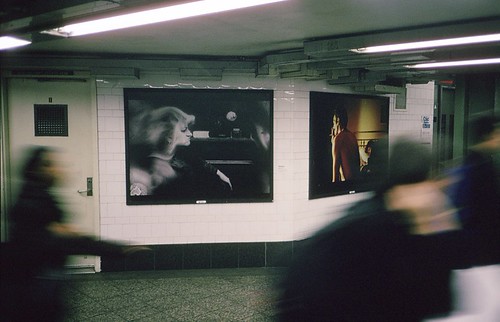
Leica MP, 35mm Summicron IV, Kodachrome 64

I don’t often shoot such slow film in the subways because there’s not a ton of light (and the light can be ugly on color film). So I braced myself against a wall and took this shot of people walking past these photographs, a temporary “installation” by the Museum of Modern Art.
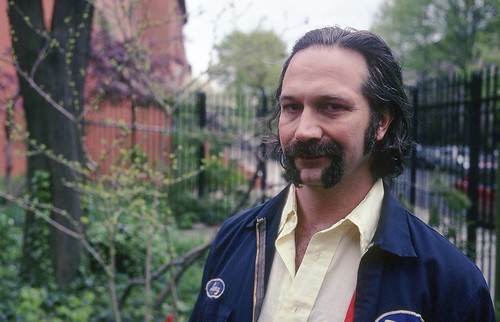
Steve. Minolta CLE, 40mm Summicron-C, Kodachrome 64

There’s something so crisp about Kodachrome. I think a lot of how I think about Kodachrome has to do with the physical piece of film itself. When you hold the slide at the right angle, you can actually see the image in relief–it’s three-dimensional.

Steve Chanks. Leica MP, 35mm Summicron IV, Kodachrome 64

It’s almost as if Kodachrome invented primary colors, isn’t it? Though my first thought for portraits would be something more flattering (less red) like Fujifilm’s Astia 100F, I think Kodachrome, with the right light, can render people’s skin pretty well. Underexposed, not so well–people start looking very ruddy, as they would with any color film. You just notice it more with positive film because it has so much less exposure latitude.

Minolta CLE, 40mm Summicron-C, Kodachrome 64

Photography’s often about seeing an idea and trying to fit it in a frame. I don’t think this is a spectacular image, but I wanted to show the repetition of all these white bars in the crosswalks and this bed frame. Click the photo and view it really close, and you can see the detail of the little stickers some child must have put on this bed.

The Minolta CLE was an ideal camera for shooting Kodachrome, for me. I enjoyed my photos from that camera the most, and after that the Yashica T4 (when it worked–it’s out of service now after hosing many rolls of Kodachrome).

Manhattan. Canon EOS 1V, Kodachrome 64

When you absolutely, positively, need a lot of 35mm camera in your hands, get a Canon EOS 1V. It was their last, flagship SLR (the 1-series DSLRs are based on it) and it’s a gorgeous beast. It’s lots of fun to shoot with, with crazy autofocus, bracketing, and a million other features I use once a year. Anyway, it’s one of the most reliable things I have in my life. I don’t shoot it on the street much (preferring a rangefinder), but when I do, I always enjoy it.

How about this light? I’ve mentioned before that Kodachrome “feels” more like a black-and-white film to me (and technically, that’s true), and part of it has to do with how inky black these shadows can get. Very satisfying.

The reader. Leica MP, 35mm Summicron IV, Kodachrome 200

Here’s a slightly friendlier film speed for shooting in a subway station (but not by much). Kodachrome by far was my favorite film for rendering the colors of New York City. It looks real, but it also looks like it rolled around in an old Scorcese film for a while, before my time in this city. Again, the shadows do so much here. Photos like this remind me that obsessing over shadow detail isn’t always a good idea.
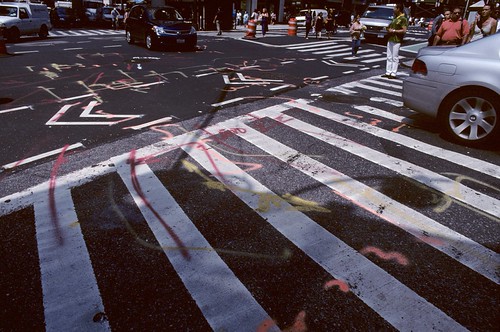
Canon EOS 1V, EF 24mm f/1.4L II USM, Kodachrome 64

I took this so I could keep this image. All these colorful markings atop all these white markings atop all this asphalt.

Leica MP, 35mm Summicron IV, Kodachrome 64

I took this outside Prospect Park on a walk with my family and our dear friend Ned who was visiting from San Francisco. I’m always attracted, photographically, to discarded reading materials and photographs. I think there’s a quick buzz one gets from doing the image-within-an-image thing, but there’s also a larger area to explore about something cast aside, or lost somehow. I really like how this magazine ended up bent so that you see Joe DiMaggio on a subsequent page and realize it’s more than just a photo of Monroe, but a whole article.

It’s interesting how this could essentially be a black-and-white photograph, but the warm tones given by the sun in the top right give this image a little extra energy.

Grand Army Plaza. Minolta CLE, 28mm M-Rokkor, Kodachrome 64

Those leaves, those browns. I like creating graphical photographs like this. It’s all about the shapes and colors and proportions. The lines are so crisp and the colors are so autumnal. As I write this, it’s really killing me that I can’t pop another couple of rolls of K64 out of the freezer and go outside and shoot.

Keeping cool on the moon. Un-noted camera and lens (probably Leica MP with 35mm Summicron). Kodachrome 64.

Not much to say about this photograph other than “I like it.”

Writing about these bits of Kodachrome pushes off the depression, so I may do one or more followup posts.

I shipped off my last rolls of Kodachrome to be processed today…

A 1977 roll of Kodachrome 25 with my Canon L1 and 50mm 1:1.4 lens

Dwayne’s Photo in Kansas needs to receive my four final rolls of Kodachrome by noon on Thursday in order to process them. I had two rolls of 64, one roll of 200, and one roll of 25 (!) that expired in 1977. I found the latter roll, unopened in its original box, in a camera bag of something I bought on eBay or Shopgoodwill or something a long time ago. I froze it and had it as a sort of collectible object, but in the Kodachrome panic of this last month, I said “fuck it” and shot it unceremoniously yesterday.

My Kodachrome shooting experience certainly went out with more of a whimper than a bang.  I shot a couple of rolls of 64 in a Leica C3, a hate-it-or-hate-it-a-little-less 35mm autofocus camera. Something’s very off about the camera, and I ended up just rewinding the final roll in it before shooting it all because I couldn’t reliably get a shot. My wife said she thinks I might subject my cameras to excessive wear, and while I rejected that idea initially, I think she’s probably right. I certainly don’t coddle them.

I shot the 200 in a Yashica Electro 35 GTN, an excellent camera for positive film, but I was shooting during this blizzard we just had, so I had to keep adjusting the ASA in order to compensate for the white everywhere. And pictures of a snowstorm just aren’t that exciting, usually. I shot the roll of 25 (I wonder how many rolls of that Dwayne’s will process this month?) with a Canon L1 (ca. 1957). Again, the snowstorm didn’t help. I was stuck inside trying to convince my toddler to sit still enough for me to get some shots. I really wanted to find some trains or some other classic subject of that amazing film. Whatever. I waited too long.

Here are some of my favorite Kodachrome shots from past rolls (I’ll post results from the above rolls when they come back):

Leica MP, 35mm Summicron IV, Kodachrome 64

Canon EOS1V, 50mm 1:1.2L, Kodachrome 64

Yashica Electro 35 GSN, Kodachrome 64

Minolta X570, (zoom lens), Kodachrome 64

Leica MP, 35mm Summicron IV, Kodachrome 64

Leica MP, 35mm Summicron IV, Kodachrome 64

Yashica T4 Super, Kodachrome 64

Canon EOS 1V, Kodachrome 64

Unremembered camera, Kodachrome 200

Leica MP, 35mm Summicron IV, Kodachrome 64

More later!