
Dover, Delaware. Taken with a Polaroid 450 Land Camera and Fujifilm FP-3000B film.
Dover, Delaware. Taken with a Polaroid 450 Land Camera and Fujifilm FP-3000B film.

Michael. Look at that grain!
Yesterday I posted my first attempt at developing in Dektol, a paper developer from Kodak.
Here are some shots of Tri-X rate at 400 in straight, undiluted Dektol. Read more…
I’m interested in trying lots of film and developer and regimen combinations; I’m not in search of the holy grail of combinations but just exploring the possibilities and hopefully learning from my mistakes and successes. In my ongoing search for gritty, high-contrast negatives, I’ve always been intrigued by talk of developing in Dektol, a paper developer. I actually bought some Dektol for that purpose several years ago, but I never mixed it up until I did a printing session one night and used it for its intended purpose.
But recently I dove right in and developed a roll of Tri-X that I had rated at EI 800 in Dektol.

Tri-X underexposed at EI 800, developed in Kodak Dektol for 2 minutes with one inversion every 15 seconds.

Arena. Tri-X underexposed at EI 800, developed in Kodak Dektol for 2 minutes with one inversion every 15 seconds.
Definitely an interesting look, but underexposed. Where it goes dark it’s just bleh with no shadow detail.
Yesterday, I took a roll that I had rated at 400 and decided to use that as my next Dektol roll. I developed it hot, at about 75F, for one minute, with three quick inversions every 15 seconds. The results were no worse than I could have expected with lots of other time/temp/exposure/film combinations, and in fact, I quite liked the effect! I’ll post those shots shortly.
Judge for yourself, and please share in the comments if you’ve ever developed with Dektol, and if so, what your experience was.

Adox CMS 20, developed in Diafine. Canon EF 50mm f/1.0L USM and EOS 1V.

Double-X at 1600 in Diafine 4+4, constant agitation using stick agitator. Leica M4 and 35mm Summicron IV.
As part of the batch of exotic film I ordered from Spain a couple of weeks ago, I bought some Double-X, a motion picture film stock which has many enthusiastic users. Usually I will shoot a new film at its box speed and find out what developer is most recommended and tweak from there. But not this time.

Double-X at 1600 in Diafine 4+4, constant agitation using stick agitator. Leica M4 and 35mm Summicron IV.
I sometimes read (and, rarely, participate in) Rangefinder Forum, which had a particularly long thread about the film. That thread has morphed into an excellent resource, Project Double-X. On that site I found a published time for Diafine using a Jobo processor. That seemed pretty wild to me because I’ve mostly used Diafine as per directions: 3 minutes, 3 gentle inversions per minute. With a Jobo, you get constant agitation. And the time in each bath was 4 minutes. I had to try it. I do own a Jobo processor, but it’s in need of a lot of repair. It’s in the pile of “fix it up some day” at the moment. But I can provide constant agitation myself.

Double-X at 1600 in Diafine 4+4, constant agitation using stick agitator. Leica M4 and 35mm Summicron IV.
So the son and I took a weekday trip to the American Museum of Natural History, which is one of our favorite places and I’ve also documented here and here and here, and I shot a roll of Double-X at 1600. Later that night I developed it in a Paterson tank, using the stir stick agitation method (no inversions). Constant agitation for four minutes in bath A, and same for bath B. Water stop, fix, and rinse/hypo/rinse.

Double-X at 1600 in Diafine 4+4, constant agitation using stick agitator. Leica M4 and 35mm Summicron IV.
The results are neither impressive nor bad. It looks like pushed black and white film, perhaps a bit grainier than is usual with Diafine. I don’t see any particular quality that jumps out as something special, though I’m quite fond of the grain in the extremely overexposed shots like the following two:

Double-X at 1600 in Diafine 4+4, constant agitation using stick agitator. Leica M4 and 35mm Summicron IV.

Double-X at 1600 in Diafine 4+4, constant agitation using stick agitator. Leica M4 and 35mm Summicron IV.
Something interesting in the development chart on the Project Double-X site is the Diafine section. If you don’t know Diafine, you basically develop all films exactly the same way. Instead of adjusting time and temperature in development to push or pull film, you find the right film speed for the film in Diafine. In other words, if you’re going to use Diafine as your developer, you shoot Tri-X at 1600 (their recommendation) or 1250 (mine). Don’t shoot it at 400. You shoot Plus-X at 400 instead of 125, etc. In this chart, using Diafine normally, it gives the film a speed of 640. But if you give less agitation, the film speed is 800. Then if you agitate the hell out of it (as I did in my case), it gives a speed of 1600. What this probably means is that many people contributed to the chart and each has a sense of what they were successful with.
I’m looking forward to playing around with the few rolls I have. I would love to establish a good speed for developing with Diafine (my summer developer), so I’ll shoot a test roll, metering carefully at 100, 200, 400, 800, and 1600 and then doing stock Diafine development. Then I’ll shoot a roll at 250 and develop in HC-110. Then I’ll try not to buy any more Double-X for a while and whittle my large stash of other film down before spending any more money.

Shay, 37th Street, Garment District
Leica M4 with 28mm Minolta M-Rokkor. Shot on Tri-X exposed at 1600 and developed in HC-110 dilution B for 16 minutes at 68F.

Crown Graphic with 127mm Ektar, Tri-X (320TXP), lit with a handheld flashlight, shot at EI 1000 and developed in Diafine using the MOD54.
Anyone have a 36-septum Grafmatic? Read more…

Clouds above New York City. NPH400, long expired, Leica M4 and 35mm Summicron IV.
I once ran into Ken Light, an excellent photographer and photojournalism professor at Columbia, shooting in Chinatown. He had a Mamiya 6 and a bag full of 400TX. He was shooting a single type of film and only that film. I love shooting one film. It makes everything so much easier, and you get better with it faster. You know the film, what it can do, what it will look like after you develop it.
But where’s the fun in that? Read more…

Simon Courchel performing in The People To Come. Leica M4, 50mm Canon 1:1.4, Delta 3200 EI 3200, Rodinal
This past weekend I had a remarkable experience: The People To Come, a participatory dance project by A Canary Torsi, a NYC dance company. Read more…
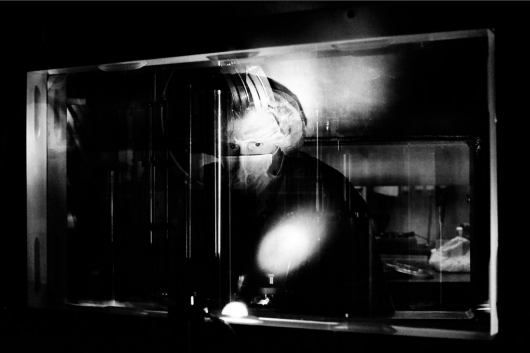
(c) Robert Shults
Practical considerations led to Robert Shults’s decision to shoot black and white, with a rangefinder, at EI 1600.
http://lens.blogs.nytimes.com/2013/06/24/robert-shults-vs-the-lasers/
 David Shoots Film