Some mistakes I don’t like to make

Botching a shot—or goodness forbid, two whole rolls—because of avoidable circumstances just sucks. I shot two rolls of Rollei 80S Retro in 120 format at the end of March. I bought them a while ago from Freestyle Photo and figured I’d give them a try. I had finally got a suitable strap for my Yashica-Mat twin lens reflex camera, so I used that.
Read more…

Ilford FP4 Plus in Diafine

My lovely Dad gave me the gift of film for xmas this year: a couple rolls each of FP4 Plus and TMAX 100. I’ve not used either of these films for years. I used to use TMX and TMY a lot in both XTOL and Diafine, but I kind of fell out with its look and moved toward Tri-X. Anyway, my Dad misunderstood my desire for fast film and thought I liked slow film. Who cares – free film is free film!
I checked the Diafine box and exposed the FP4 Plus at ISO250. Standard Diafine development.

Amdie, shot on FP4 Plus, developed in Diafine


Read more…

The joy of using Rodinal to push Tri-X

Developing Tri-X shot at 1600 in Rodinal 1+50 yields excellent results. I shot these with a Leica MP and 35mm Summicron IV. I took a meter reading off my hand in each area I shot.

It’s the season for not using Diafine: the cabinet in which I keep my chemicals never breaks 70 degrees during the cold months, and mixing a one-shot developer like Rodinal or HC-110 is a lot faster and easier than warming my Diafine A & B bottles in a tempered bath. Diafine’s working range is 70-85 degrees Fahrenheit. I still use it, but I extend the development times from 3 minutes in bath A and 3 minutes in bath B to more like 4 minutes/5 minutes. I don’t know if that overcomes the temperature being too low. Read more…

Archive: Kiev 4A, Jupiter 8M, T-MAX, and Diafine

Intrigued by Shinya Arimoto’s refrigerator full of TMX/TMY and HC-110, I was looking through my archives, looking for what I’ve done with these films and with what developers. I’m somewhat new to HC-110, but I’m wondering if I’ll bother trying it right away, given these examples of 35mm TMX in Diafine, shot between 75 and 100 ISO.

I’m going to try this combo of TMX and Diafine in 120.

Bed-Stuy: 3x6x6

I think any of these would have looked great in black-and-white, but the color captures an extra dimension of texture, and perhaps time.

“Lost” Robert Frank photos on NYT Lens blog

Robert Frank


http://lens.blogs.nytimes.com/2012/02/17/a-lonely-gaze-on-the-times-and-its-city/

I can’t say anything about Robert Frank’s photography that won’t sound like hyperbole, so I’ll just say that his work is really important to me. View the dozen images on the blog at the link above in full-screen mode. If you’re a black-and-white film photographer like me, you might appreciate the inky blacks and the pronounced grain. This was definitely a shot in the arm for me this morning, and I fully intend to exploit my lunch break with my Leica, 28mm lens, Tri-X, and Manhattan.

Taking a critical look: roll 2011-0026 part 2

Continued from yesterday’s post.

For this post, I want to talk “out loud” about how I select photos and, more importantly, how I reject photos. I realized last night that it’s one of the most difficult and time-intensive things I do (sometimes several hours a night)–much more difficult than developing the film or, often, taking the photographs in the first place.
Here are some photos from a single roll I took in April. The film is Arista Premium 100 (which is re-packaged Kodak Plus-X) from Freestyle Photo, which I developed in Diafine. I shot these all with a Leica MP, mounted with a 28mm Minolta M-Rokkor lens originally designed for the Minolta CLE.
Recently I’ve fallen back into a “practice” mode of sorts because I’m not technically as good as I need to be: I tend to shoot while moving, and so I get too much blur, and I don’t have a good grasp of distance for proper, fast focusing. So on this roll, I was trying to get a lot of shots of people in focus, regardless of whether or not the photo was any good. But you still hope for that one good shot!
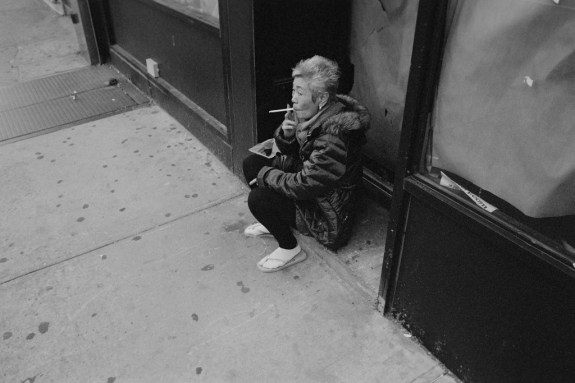
Image 7

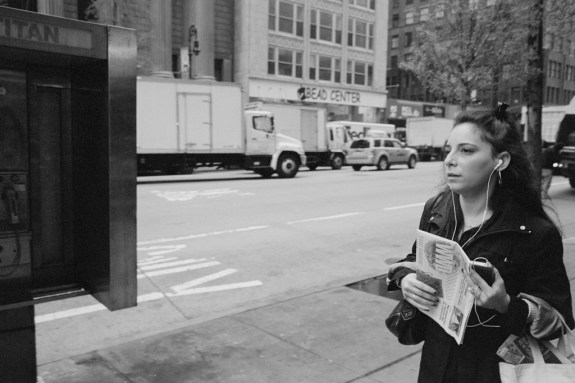
Nothing that interesting here. But, this is a successful photograph for me on at least one level: she’s in focus. I’ve been practicing zone-focusing, which is basically defining a depth of field and accepting a certain level of sharpness within that field. I think I’m getting pretty good at it. Shooting film makes this a little more difficult–you can’t instantly see the results of what you’re doing. That’s why I carry a notebook. I don’t keep track of each shot that I take, but I can make a note that I’m trying for “deeper DOF/faster shutter speed” and note typical f-stops, etc. Then when I’m editing the photos, I see that note and review the photos with that in mind. If I actually take a good photo in the process, all the better. This isn’t a good photo. Like Image 4 above, I should have tipped down a bit. She doesn’t need to be smack-dab in the horizontal center of the frame. The phone booth is a monstrous distraction. And there’s nothing going on. Final negative: the Bead Center across the street with its atrocious Comic Sans sign. It’s so bad. And it’s pretty new. One should not photograph such crap.
Read more…

Taking a critical look: roll 2011-0026, part 1

For this post, I want to talk “out loud” about how I select photos and, more importantly, how I reject photos. I realized last night that it’s one of the most difficult and time-intensive things I do (sometimes several hours a night)–much more difficult than developing the film or, often, taking the photographs in the first place.
Here are some photos from a single roll I took in April. The film is Arista Premium 100 (which is re-packaged Kodak Plus-X) from Freestyle Photo, which I developed in Diafine. I shot these all with a Leica MP, mounted with a 28mm Minolta M-Rokkor lens originally designed for the Minolta CLE.
Recently I’ve fallen back into a “practice” mode of sorts because I’m not technically as good as I need to be: I tend to shoot while moving, and so I get too much blur, and I don’t have a good grasp of distance for proper, fast focusing. So on this roll, I was trying to get a lot of shots of people in focus, regardless of whether or not the photo was any good. But you still hope for that one good shot!

Image 1

I took this on a morning walk with my son and dog. I was attracted by this woman’s look and the fact that she’s framed by this doorway and dirty sidewalk. She’s smoking, which brings an interesting expression to her face and hand. But really that’s all about it for me. My composition was hasty as I wanted to get this before she was done inhaling, and I didn’t want her to feel self-conscious. If I saw this scene again, I would shoot it again, but I would probably place her further right in the frame, and maybe move myself to get her a little more head-on. It’s easy for me to like a photo I’ve taken only because there’s a person (or more) in it. I have to push back against that. People don’t always make interesting subjects, and I’m not often a good photographer. So even if I could reshoot this, I would probably still reject it because I can’t see it becoming that much more interesting unless I got up really close.
Read more…
New old street photography


Fifth Avenue, Leica MP, 35mm Summicron, Plus-X, Diafine

Garry Winogrand didn’t develop his film until at least a year after he took it (according to him). As an always-learning photographer, I have always found that fascinating. How could you not look at what you just shot and make notes as to exposure, development time, composition, etc.? But I shot too much film last year (almost 300 rolls, not including instant film and digital) and I’m still developing stuff from back in September/October.
Read more…

An inspiring interview

http://blakeandrews.blogspot.com/2009/03/q-with-jeff-ladd.html

I love how this guy talks about photography. He basically answered some questions that I hadn’t thought to pose, or hadn’t thought through completely. His musings on composition and order are especially satisfying.